
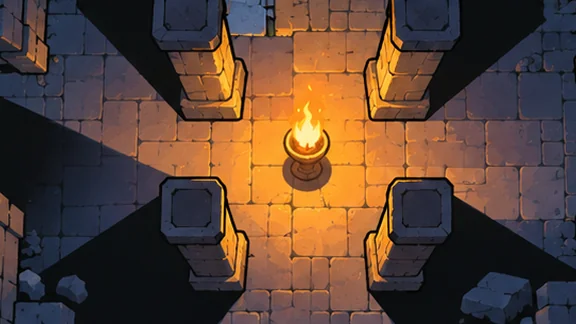
Shadow casting

Place the light beside a block. Trace a dark edge back toward the light and see which corner made it.
Interactive demo#Shadows#Shadow
Walls really block a light, leaving dark wedges behind them.
From the light, the game stretches each wall edge outward and fills the area behind it with darkness. Unlike the shortcuts above, this is worked out from the scene, so it’s used for torches in dungeons and for line of sight in stealth games.
Code
namespace shadow_casting_lesson;
import stage;
import std;
import math;

export "shadow-casting" fn draw(time: f64, dt: f64, px: f64, py: f64, hover: bool) {
    let blocks = [[38, 22, 18, 18], [100, 16, 14, 28], [66, 62, 30, 12], [24, 64, 12, 12], [126, 62, 14, 14]];
    lit_floor(px, py);
    for b in blocks {
        cast_shadow(b[0], b[1], b[2], b[3], px, py, "rgba(14,15,38,.82)");
    }
    for b in blocks {
        draw_block(b[0], b[1], b[2], b[3]);
    }
    lamp(px, py);
}
Comments
No comments yet.